
TTS textile recyling
Textile Recycling at TTS
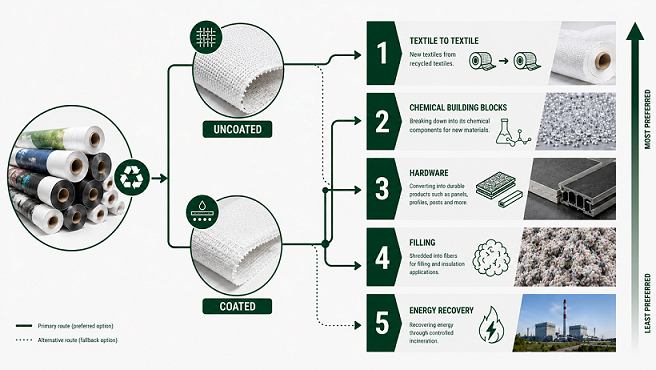
The recycling ladder as a guideline for the right application for each type of textile
At TTS, we do not consider returned textiles to be waste, but a valuable raw material. At the same time, we recognize that textile recycling is not a one-size-fits-all solution. The technical composition of a textile largely determines which form of reuse or recycling is possible. That is why we work with a clear recycling ladder, helping us determine the most sustainable and realistic route for each type of textile.
Why the distinction between coated and uncoated textiles is crucial
TThe position of a textile on the recycling ladder is largely determined by whether the material is a mono-material stream.
- Uncoated textiles (such as Flag and Display fabrics) consist primarily of a single material and are therefore suitable for the highest and most circular step.
- Coated textiles (such as Blackback Soft and Heavy Tent) consist of multiple material components and require alternative applications lower on the ladder.
At TTS, we deliberately apply a recycling ladder approach. Rather than looking for one fixed solution, we assess each type of textile — coated or uncoated — to determine which step delivers the highest added value. In this way, we make our choices transparent and work together with our customers towards a realistic and future-proof circular textile chain.
Step 1 – Textile-to-Textile Recycling
High-value circularity for uncoated textiles
The highest step on the recycling ladder is textile-to-textile recycling. In this route, used textiles are processed back into raw materials for new textiles, keeping the material entirely within the textile chain. This is the most circular application possible.
This step is particularly suitable for uncoated polyester textiles, such as flag and display fabrics. These textiles mainly consist of a single material, making them a mono-material stream. Because the material is homogeneous and contains no additional layers, it can be broken down into its base material and rebuilt into new fibres.
This form of recycling uses chemical recycling, in which the polyester is broken down at a molecular level, purified, and repolymerised. The result is a new fibre that can once again be used in textile production.
Coated textiles are currently not suitable for this stage of the recycling process. Due to the presence of coatings, these materials consist of multiple components, which significantly increases the cost of this form of recycling. The coating must first be removed from the process, while it adds no recycling value. Although technically possible, this is not economically viable in practice. For this reason, chemical recyclers do not accept coated textiles.
Step 2 – Textile-to-Chemical Building Blocks
A new circular route for complex and coated textiles
A relatively new development within textile recycling is thermochemical recycling. This method is intended for textile streams that are not suitable for Step 1 – textile-to-textile recycling.
In this process, textiles are broken down at high temperatures in the absence of oxygen into chemical building blocks such as synthesis gas or aromatic molecules. These substances can then be used as raw materials for new chemicals or plastics, including feedstock for new polyester products.
This step is particularly relevant for coated textiles and mixed textile streams. Due to their multi-layered structure (base fabric combined with coatings, additives, or finishes), these materials are not mono-material streams and are therefore difficult to recycle into new fibres. Thermochemical recycling offers an alternative in which the fossil carbon contained in the material is retained and reused within industrial value chains.
Although this route does not directly return the material to textiles, it remains higher on the ladder than applications where only the material’s physical form or volume is utilised.
Step 3 – Textile-to-Hardware
Durable reuse for coated textiles
When textiles are not suitable for textile-to-textile recycling, attention shifts to applications outside the textile chain but with a long service life. This is the third step: textile-to-hardware.
This route is particularly suitable for coated textiles such as Blackback Soft and Heavy Tent. These textiles consist of a supporting fabric combined with one or more coatings that provide properties such as light blocking or weather resistance. Due to this multi-layered structure, coated textiles are not mono-material streams, which makes recycling into new fibres more difficult.
At the same time, these very properties make the material highly suitable for hardware applications. Through mechanical processing, the textile can be transformed into rigid products such as boar]ds, poles, or other functional applications with a long lifespan. Although the textile leaves the textile chain, it retains its value in a durable new function.
Step 4 – Textile-to-Filling
Functional reuse for complex material streams
If processing into hardware is not suitable, the fourth step offers a meaningful alternative: textile-to-filling. In this route, the textile is shredded and reused as filling material.
This step is also mainly applicable to coated textiles and more complex or mixed textile streams. These include materials with multiple properties or residual components that make higher-value applications less practical.
The
shredded textile is used in applications where volume and cushioning are
important, such as cushions, sports and training equipment (for example
punching bags), or protective and cushioning products (such as insulation
materials). Although this is a lower step than hardware applications, this
route still ensures that the material gains a new function instead of being
prematurely discarded.
Step 5 – Textile-to-Energy
Final option for non-reusable textiles
The lowest step on the recycling ladder is incineration with energy recovery. This is the application that TTS aims to avoid for as long as possible.
This step is only considered when textiles — coated or uncoated — are unsuitable for reuse or recycling due to their composition, contamination, or condition. In such cases, the material can still be used to generate heat or electricity.
Although
this is not a circular solution and the material permanently leaves the chain,
it is still utilised in a controlled and functional manner within this step. Within
our approach, this is always the final option.